


A burst pipe, overflowing toilet, blocked drain, or sudden loss of hot water can turn an ordinary day into a serious household problem within minutes. In Melbourne, where older homes, renovated properties, apartments, and modern developments can have very different plumbing systems, knowing what to do before a plumber arrives can prevent further damage and reduce repair costs.
When a plumbing problem cannot safely wait until the next business day, contacting an emergency plumber Melbourne residents can rely on is often the right decision. However, calling a professional is only one part of handling a plumbing emergency. The first few minutes matter too.
Knowing where your main water isolation valve is, understanding which fixtures you can safely shut off, and recognising when a plumbing issue is becoming a property-damage or safety concern can make a significant difference.
This guide explains what to do when a plumbing emergency happens, when professional assistance is warranted, common mistakes to avoid, and how experienced plumbers approach urgent situations.
What Counts as a Plumbing Emergency?
Not every plumbing problem requires an emergency response. A dripping tap or slowly draining basin may be inconvenient, but it can often wait for a scheduled appointment.
An emergency is generally a plumbing problem where delaying action could result in significant water damage, sanitation problems, property damage, or loss of an essential service.
Examples include:
The important distinction is risk and urgency, not simply inconvenience.
For example, a small leak beneath a bathroom vanity may appear manageable. If the water is continuously running into cabinetry or flooring, however, leaving it overnight could cause swelling, mould growth, damaged flooring, or hidden structural damage.
That is where emergency plumbing services Melbourne homeowners use become particularly valuable: the objective is to contain the problem first and determine the permanent repair once the immediate risk has been controlled.
Emergency Plumbing: What to Do First
When water is escaping unexpectedly, people often panic and immediately start searching for a plumber. Calling a professional is sensible, but there are a few immediate steps that can help limit damage while assistance is being arranged.
1. Stop the Water Supply
If water is actively escaping from a pipe, tap, toilet, or appliance, shut off the relevant isolation valve if you can safely access it.
For a local fixture, there may be a small isolation valve nearby. If you cannot identify the correct valve or the leak is substantial, locate the property’s main water isolation point.
Do not force a valve that is seized or damaged. Older plumbing systems can have brittle components, and excessive force may create another leak.
If you live in an apartment, the water shut-off arrangement may be different. Your individual apartment may have an isolation valve, while some building-level plumbing requires assistance from building management.
2. Protect People From Hazards
Water and electricity are a dangerous combination.
If water is reaching electrical outlets, appliances, switchboards, or electrical cabling, do not stand in the water and attempt to reach electrical equipment.
Instead, keep people away from the affected area and contact the appropriate licensed professionals. If there is an immediate electrical danger, emergency electrical assistance may also be required.
Similarly, if you suspect a gas leak, avoid creating ignition sources such as switches, flames, or electrical equipment and follow appropriate gas emergency procedures.
3. Move Valuable Items
Once the immediate water source has been controlled and the area is safe, move furniture, electronics, documents, rugs, and other valuables away from the affected area.
Even a relatively small amount of water can travel underneath flooring and into cabinetry.
If water has already reached carpets or flooring, photographs taken before major cleanup can also help document the condition for insurance purposes.
4. Contact a Qualified Plumber
Once the immediate situation is under control, arrange professional assessment.
For problems that cannot safely wait, an emergency plumber Melbourne service can assess the source of the failure, isolate affected sections, identify secondary risks, and determine what repair is required.
Avoid assuming that stopping visible water means the problem has been fixed. A leak may have travelled behind walls, beneath flooring, or through cabinetry.
Why Fast Action Matters in Melbourne Homes
Melbourne’s housing stock includes everything from older Victorian terraces and weatherboard homes to contemporary townhouses and high-rise apartments.
That diversity affects how plumbing emergencies develop.
Older properties may have ageing pipework, deteriorated seals, outdated fixtures, or plumbing modifications accumulated over decades. Newer homes may have more complex systems involving multiple appliances, concealed pipework, water-saving fixtures, and specialised fittings.
In either situation, a visible symptom does not always identify the actual source.
For instance, water appearing around a bathroom floor may not originate from the floor itself. It could be coming from:
An experienced plumber therefore investigates the pathway of the water rather than simply repairing the point where it becomes visible.
Same Day Plumbing Service Melbourne: When Is It Enough?
Not every urgent plumbing issue needs a middle-of-the-night response.
A same day plumbing service Melbourne homeowners use may be appropriate when a problem is important but has been successfully contained.
Consider a leaking tap that has been isolated at its fixture valve. The issue still needs repair, but if there is no ongoing water escape or property risk, an immediate after-hours visit may not be necessary.
On the other hand, a burst pipe that cannot be isolated, an overflowing sewer, or significant water entering a building is a different situation.
A useful way to assess urgency is to ask:
If the answer to one or more of these questions is yes, professional assistance should generally be arranged promptly.
Urgent Plumbing Melbourne: Common Emergencies and What to Do
Burst or Severely Leaking Pipes
A burst pipe can release a surprisingly large amount of water in a short period.
The priority is isolation.
Turn off the appropriate water supply if it is safe to do so, then remove people and valuables from the affected area. Do not attempt a permanent repair with household tape, glue, or improvised fittings.
Temporary measures may slow a leak but are not a substitute for assessing pipe condition and pressure.
A plumber will typically need to identify the failed section, isolate it, replace or repair the affected component, and check whether the surrounding system has suffered additional damage.
Overflowing Toilet
A blocked toilet becomes an emergency when wastewater is overflowing or approaching the rim.
The first step is to stop further flushing.
If there is an accessible isolation valve behind or near the toilet, close it. Then keep the area clear.
Repeatedly flushing in the hope that the blockage will clear is one of the most common mistakes. If the obstruction remains, additional flushing can turn a manageable blockage into contaminated water spreading across the bathroom floor.
Do not automatically pour harsh chemical drain products into the toilet. They may not resolve the obstruction and can create chemical hazards for anyone who subsequently works on the plumbing.
Sewage Backup
Sewage entering a home requires prompt attention because the issue involves both plumbing and hygiene.
Avoid unnecessary contact with contaminated water. Keep children and pets away from the affected area and do not use affected fixtures until the source has been assessed.
A sewage backup can result from a blocked sewer line, damaged pipework, tree-root intrusion, inadequate drainage, or other faults.
The visible wastewater is only part of the problem. The underlying cause needs to be identified to prevent recurrence.
Major Drain Blockage
A slow drain is usually an early warning rather than an emergency.
A drain that suddenly stops flowing, backs up into a shower, or causes wastewater to rise from another fixture is more concerning.
If multiple fixtures are draining slowly at the same time, the issue may be further along the drainage system rather than being limited to one sink.
For example, if a kitchen sink, laundry drain, and bathroom fixtures are all affected, treating each individual drain separately may miss the main obstruction.
Hot Water System Failure
Loss of hot water is not always an emergency, but some failures require prompt attention.
A leaking hot water system can cause property damage, while unusual noises, pressure problems, or water escaping from components may indicate a mechanical or plumbing fault.
Never dismantle a hot water system yourself if you are unsure of its operation. Depending on the system, repairs can involve water pressure, electricity, gas, heating elements, valves, or other components.
A qualified professional can determine whether the problem is plumbing-related or requires another licensed trade.
24 Hour Plumber Melbourne: What to Expect From an Emergency Callout
Searching for a 24 hour plumber Melbourne residents can contact is often the first step during a serious plumbing incident, but it is useful to understand what an emergency callout actually involves.
A professional emergency response should focus first on stabilising the situation.
The plumber may:
Emergency plumbing does not always mean the entire plumbing system will be replaced immediately.
In many cases, the correct first step is to stop the active failure and make the property safe. A more extensive repair can then be planned properly.
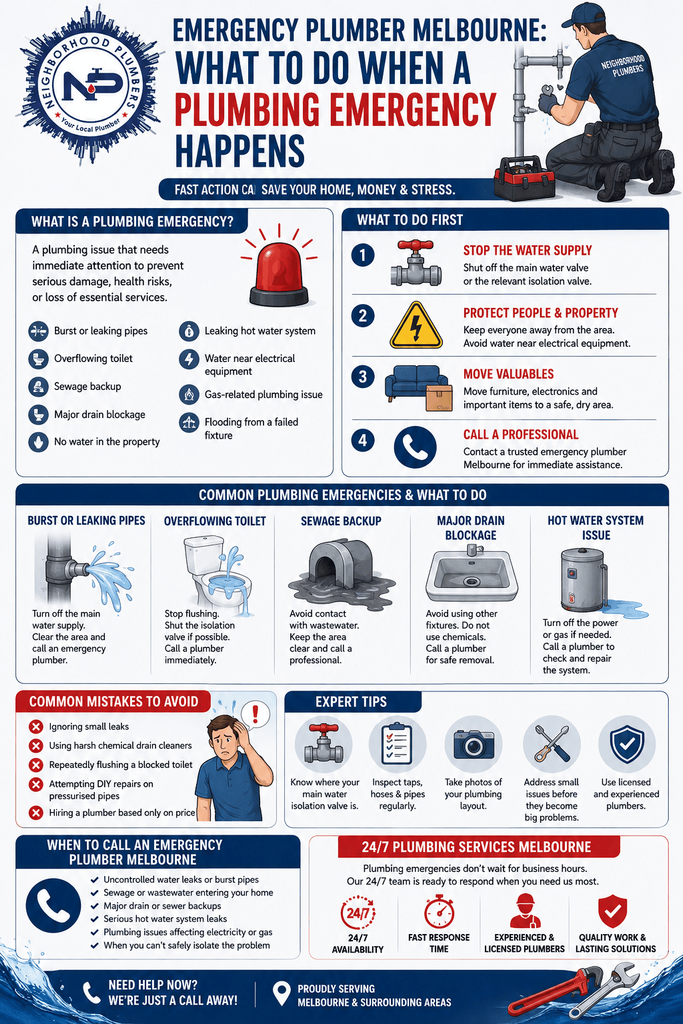
What 24/7 Plumbing Services Melbourne Should Actually Provide
The term 24/7 plumbing services Melbourne describes availability, not automatically quality.
When choosing an emergency plumbing provider, look beyond the promise of being available around the clock.
Consider whether the plumber:
A genuine emergency response should be focused on solving the immediate problem, not creating unnecessary urgency.
Before approving substantial additional work, ask what has failed, what needs to be repaired now, and what can safely be addressed later.
Common Mistakes Homeowners Make During Plumbing Emergencies
Waiting Because the Leak Looks Small
Small leaks can become expensive when they continue for hours.
Water can enter timber cabinetry, flooring, plasterboard, insulation, and concealed cavities. The visible amount of water is not necessarily an indication of the total damage.
Using Too Much Chemical Drain Cleaner
Chemical drain cleaners are often treated as a universal solution for blocked drains.
They are not.
A blockage caused by foreign material, structural damage, tree roots, or a significant obstruction may not respond to chemicals. Incorrect use can also damage plumbing components or create a hazardous environment for someone working on the drain.
Repeatedly Flushing a Blocked Toilet
This is particularly risky when the toilet bowl is already filling.
Once it becomes clear that the water is not draining normally, stop flushing and isolate the supply if possible.
Trying to Repair a Pressurised Pipe
Improvised repairs may not withstand water pressure.
A temporary patch that fails can release substantially more water than the original leak.
Ignoring Multiple Drain Problems
When several fixtures suddenly drain slowly or back up, the problem may be located deeper within the drainage network.
Treating only one fixture can provide temporary relief without addressing the underlying restriction.
Choosing a Plumber Based Only on the Cheapest Callout
Emergency pricing can vary for legitimate reasons, including time of day, travel, complexity, parts, equipment, and labour requirements.
The lowest initial price does not necessarily mean the lowest total cost.
The more useful comparison is whether the provider clearly explains the callout, labour, parts, after-hours charges, and proposed repair.
Expert Tips for Handling Plumbing Emergencies
Know Where Your Main Water Isolation Valve Is
Do this before an emergency happens.
If you have recently moved into a property, locate the main isolation point and make sure household members know where it is.
This simple preparation can save valuable time during a burst pipe.
Photograph the Plumbing Layout
For unfamiliar properties, photographs of the main water isolation point, hot water system, and major plumbing fixtures can help household members identify equipment quickly.
This is particularly useful for rental properties, large homes, and properties with multiple levels.
Do Not Hide the Problem Before the Plumber Arrives
If you have already attempted a temporary repair, tell the plumber exactly what you did.
Information about when the leak started, whether the water was clean or contaminated, and what valves have been closed can help with diagnosis.
Watch for Secondary Damage
After a leak is stopped, look for:
These signs can indicate that water has travelled beyond the original leak.
Ask What Caused the Failure
A good repair should ideally address more than the symptom.
If a flexible hose has failed, for example, the plumber should assess the connection and surrounding components rather than simply restoring water flow without considering why the failure occurred.
How to Prepare for a Plumbing Emergency Before It Happens
The best emergency plumbing strategy is prevention and preparation.
Keep these items accessible:
It is also worth periodically checking exposed plumbing components for corrosion, deterioration, leaks, or unusual movement.
Flexible hoses, taps, toilet connections, valves, and exposed pipework should not be ignored simply because they are still functioning.
Early replacement of a visibly deteriorated component is usually far easier than dealing with a failure after water has entered the property.
When You Should Call an Emergency Plumber Melbourne
A professional should be contacted promptly when you cannot safely control the plumbing problem yourself or when delay could cause significant damage.
Situations that commonly justify emergency assistance include:
If you can safely isolate the problem and there is no immediate risk, a scheduled or same day plumbing service Melbourne appointment may be sufficient.
The key is to judge the situation based on consequences rather than simply how inconvenient it feels.
Conclusion
A plumbing emergency is stressful, but the right response is usually straightforward: control the water, protect people, minimise property damage, and get professional help when the problem cannot be safely contained.
Understanding the difference between a minor plumbing inconvenience and a genuine emergency can also help you make better decisions about when to seek immediate assistance.
Whether you need an emergency plumber Melbourne homeowners can contact during a burst pipe, sewage backup, major leak, or serious drainage failure, preparation matters just as much as response time. Knowing your isolation points, avoiding risky DIY repairs, and recognising warning signs can significantly reduce the consequences of a plumbing failure.
Most importantly, don’t focus only on stopping the visible symptom. The underlying cause needs to be properly identified so the same problem does not return.
For serious incidents that cannot safely wait, professional emergency plumbing services Melbourne residents use can help stabilise the situation, identify the cause, and restore the plumbing system safely.
Frequently Asked Questions
1. What should I do first when a pipe bursts?
The first priority is to stop or isolate the water supply if you can do so safely. Move people away from the affected area, particularly if water is near electrical equipment, and protect valuables where possible. Then contact a qualified plumber.
Do not attempt to cut, drill, or dismantle a pressurised pipe yourself. Once the immediate water flow has been controlled, a plumber can identify the failed section and determine whether the repair is isolated or evidence of a wider plumbing problem.
2. Is a blocked drain considered a plumbing emergency?
It depends on the severity and consequences of the blockage. A slowly draining bathroom basin can usually wait for a standard appointment. A blocked drain that causes wastewater to back up into a shower, laundry, bathroom, or living area requires much faster attention.
Multiple blocked fixtures are particularly important because they may indicate an obstruction further along the drainage system rather than a problem with one individual fixture.
3. Should I use chemical drain cleaner before calling a plumber?
Generally, avoid relying on chemical drain cleaners for serious or unexplained blockages. They may not resolve mechanical obstructions, tree-root intrusion, damaged pipes, or deeper drainage problems.
They can also leave hazardous chemicals inside the plumbing, creating additional risks for anyone who later needs to inspect or repair the system. For a severe blockage, professional diagnosis is usually the safer approach.
4. What is the difference between a 24 hour plumber and emergency plumbing?
A 24 hour plumber Melbourne service generally indicates that a plumber can be contacted outside standard business hours. Emergency plumbing refers to the urgency and nature of the plumbing problem itself.
A plumber may operate 24 hours but not every after-hours issue is necessarily an emergency. Conversely, a serious burst pipe or sewage backup may require immediate assistance regardless of the time.
5. How can I prevent plumbing emergencies at home?
Regular inspection and early maintenance are among the most effective ways to reduce emergency failures. Look for dripping valves, corroded fittings, damaged flexible hoses, recurring drain blockages, water stains, and unusual changes in water pressure. Know where your main water isolation valve is and make sure everyone in the household knows how to access it. Addressing small defects before they become failures can prevent much larger water-damage incidents.

Neighborhood Plumbers were fantastic! They fixed my leaking pipes quickly and professionally. Great service, fair pricing, and friendly staff. Highly recommended!

Called Neighborhood Plumbers for a blocked drain, and they sorted it out efficiently. Courteous, knowledgeable, and affordable. Will definitely use them again!
Exceptional service! They arrived on time, diagnosed the issue fast, and had my hot water system running again in no time. Reliable and skilled team!


