


A slow-draining sink is easy to ignore.
At first, the water takes a few extra seconds to disappear. Then you notice a faint smell. A week later, the bathroom drain is barely coping, and one more shower leaves water sitting around your feet.
This is how many blocked drains start.
For minor buildup, a sensible DIY approach can sometimes solve the problem. But not every blockage is sitting within reach of a household plunger. Some are caused by compacted debris, grease deeper in the pipe, tree roots, damaged pipework, or a blockage further along the drainage system.
Knowing the difference matters.
A simple blockage may need only basic maintenance. A recurring or severe blockage may need professional diagnosis and blocked drain repair Melbourne services before the problem becomes more disruptive.
This guide explains what homeowners can safely try themselves, when DIY drain cleaning is unlikely to help, and the signs that it is time to call a professional. It also explains how a blocked drain specialist Melbourne service can approach a difficult blockage without relying on guesswork.
Before reaching for a chemical cleaner, it helps to understand what may actually be happening inside the pipe.
Different drains tend to develop different problems.
Kitchen sinks commonly collect:
Grease can be particularly troublesome because it may enter the pipe as a liquid and then cool and stick to the pipe walls. Over time, other debris can attach to this buildup.
Bathroom drains often deal with:
A bathroom basin that slowly gets worse over several weeks may have a restriction developing close to the waste outlet.
Hair is one of the most common causes of shower drainage problems. Hair can combine with soap residue and form a dense mass that restricts water flow.
Toilet blockages can be caused by excessive toilet paper, unsuitable items being flushed, or an obstruction deeper within the drainage system.
A toilet that repeatedly blocks, particularly when other fixtures are also affected, should not automatically be treated as an isolated toilet problem.
Not every slow drain requires a plumber immediately.
If the problem is minor and isolated to one fixture, there are a few sensible first steps you can consider.
Remove visible hair, lint, food debris or other material around the drain opening.
This sounds obvious, but it is often overlooked. A surprising amount of bathroom drainage buildup sits close to the surface.
Use gloves and place removed material into the rubbish rather than washing it further into the pipe.
A suitable plunger can sometimes dislodge a minor obstruction.
For the best chance of success:
The aim is to move a minor obstruction, not to force a stubborn blockage deeper into the system.
For some sinks, the trap underneath the basin can collect debris.
If you are comfortable working on accessible plumbing components, the trap can sometimes be cleaned. Place a container underneath before opening it because trapped water and debris may come out.
If the connection is difficult to access, corroded, leaking, or difficult to reassemble securely, it is better to stop rather than turn a drainage problem into a plumbing leak.
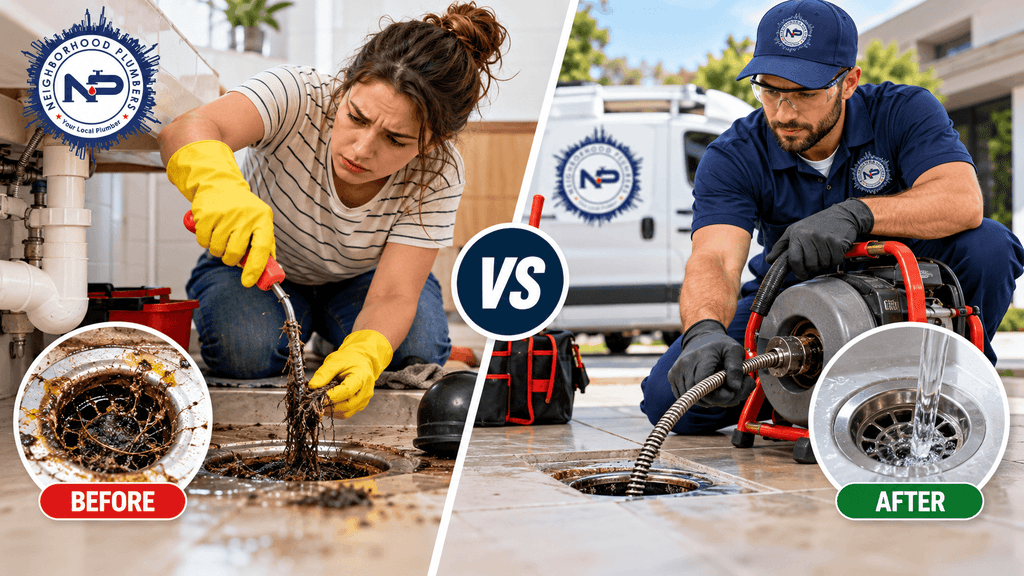
Once a drain is flowing normally, prevention can make a significant difference.
Consider:
These simple habits can reduce the amount of material entering the drainage system.
The biggest mistake homeowners make is assuming that every blockage is a surface blockage.
If you have removed visible debris and tried reasonable basic measures but the drain remains slow, there may be another problem further inside the pipe.
This is where repeated DIY attempts can become counterproductive.
For example, imagine a kitchen sink that drains slowly. You remove debris from the plughole and the water improves temporarily. Two days later, the same problem returns.
That pattern is useful information.
It suggests the obstruction may not have been completely removed. There could be a buildup further down the line that continues to restrict the flow.
Repeatedly treating the symptom without finding the cause can waste time and delay proper repairs.
Some warning signs should move the problem beyond DIY maintenance.
A drain that repeatedly becomes blocked is rarely something to ignore.
If it has been cleared several times but continues to slow down, professional investigation can help determine why.
Possible causes include:
A professional drain clearing service can assess the situation rather than simply trying to push the blockage further along.
This is one of the more important warning signs.
If the kitchen sink, shower, laundry drain or toilet are all draining slowly around the same time, the problem may be located in a shared drainage line.
That is very different from a small blockage directly beneath one sink.
In this situation, cleaning one fixture may provide little or no lasting improvement.
Suppose you run the washing machine and water appears in a shower drain.
Or you flush a toilet and hear bubbling from a nearby basin.
These symptoms can indicate that wastewater is struggling to move through a shared section of the drainage system.
It is generally better to have the issue assessed rather than continuing to use multiple fixtures and potentially worsening the backup.
A persistent sewage odour should not simply be masked with air freshener.
The smell may be associated with stagnant wastewater, a drainage obstruction, a trap problem, or another plumbing issue.
The correct response is to identify the source rather than treating the smell as the problem itself.
Standing wastewater is a stronger warning sign than a mildly slow drain.
If wastewater is backing up into a shower, sink or floor waste, avoid unnecessary water use until the cause is understood.
If sewage is involved, take appropriate hygiene precautions and arrange professional assistance.
Professional drain cleaning is not simply a stronger version of using a household product.
A plumber first needs to understand what is causing the restriction.
Depending on the circumstances, professional equipment may be used to locate and clear the obstruction.
The plumber may assess:
These observations help narrow down the likely cause.
Specialised equipment can be used to break up or remove certain obstructions.
The appropriate method depends on the pipework, location and type of blockage. Using excessive force without understanding the pipe condition can create additional problems, so professional judgement matters.
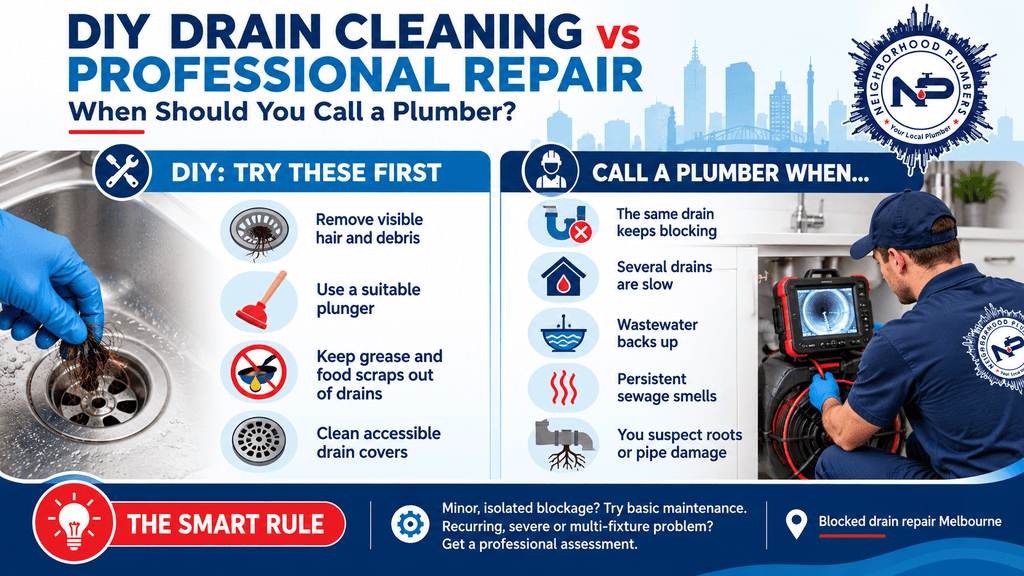
In suitable drainage systems, specialised water-jetting equipment can help remove stubborn buildup from inside pipes.
The objective is not simply to make water move again. Proper cleaning aims to remove as much of the restricting material as practical.
For recurring or unexplained blockages, a drain camera can provide valuable information.
A camera inspection may help identify issues such as:
This is particularly useful when a drain repeatedly blocks despite being cleared.
The right approach depends on the symptoms.
| Situation | DIY approach | Professional assessment |
| Slightly slow sink | Reasonable first step | Not always necessary immediately |
| Visible hair around shower drain | Remove visible buildup | Consider if the problem returns |
| One drain repeatedly blocks | Limited usefulness | Recommended |
| Multiple drains are slow | Unlikely to solve the cause | Recommended |
| Wastewater backs up | Avoid repeated DIY attempts | Recommended |
| Persistent sewage smell | Investigate rather than mask | Recommended |
| Suspected damaged pipe | DIY is unsuitable | Professional inspection |
| Suspected tree roots | DIY is unlikely to resolve it | Professional assessment |
The key question is not simply, “Can I clear this drain?”
It is:
“Why is this drain blocked, and is the problem likely to return?”
That distinction saves homeowners from repeatedly treating the same symptom.
Chemical products can appear attractive because they are quick and widely available.
However, stronger does not automatically mean better.
Incorrect use can create safety risks, damage some plumbing components, and leave hazardous residue in a drain that a plumber later needs to work on.
Always follow the product label. Never mix different drain-cleaning chemicals.
If a blockage is persistent, professional diagnosis is generally more useful than repeatedly adding chemicals.
A drain that is already backing up should not be treated as normal.
Continuing to send large amounts of water through a restricted system can increase the amount of wastewater that backs up elsewhere.
Improvised tools can damage plumbing or push debris deeper into the system.
If a blockage cannot be reached safely, stop rather than forcing the issue.
A hair blockage near a shower drain and a root intrusion in an underground drainage line are completely different problems.
The solution needs to match the cause.
This is perhaps the most expensive mistake over time.
If a drain needs clearing again and again, the repeated blockage is telling you something.
Instead of repeatedly restoring flow, investigate why the restriction keeps returning.
Knowing when to stop DIY work is just as important as knowing what you can attempt yourself.
A blocked drain specialist Melbourne service becomes particularly useful when the blockage is severe, recurring, difficult to locate, or affecting multiple fixtures.
Professional assistance is worth considering when:
The advantage of professional blocked drain repair Melbourne is not simply access to specialised equipment. It is the ability to assess the drainage system and choose an appropriate method based on the actual problem.
Consider a homeowner whose kitchen sink becomes slow every few months.
Each time, they remove visible debris and use a household drain treatment. The sink improves for a while, so the problem appears solved.
Then it happens again.
After several cycles, the homeowner arranges a professional assessment.
The important finding is not necessarily the exact equipment used to clear the drain. It is that the repeated blockage indicates an underlying restriction that was never fully addressed.
This is a common lesson with drainage work:
Temporary flow does not always mean the pipe is properly clear.
If a blockage repeatedly returns, treat the recurrence as useful diagnostic information.
Professional drain clearing services Melbourne homeowners use can solve an existing blockage, but everyday habits still matter.
Allow cooking fats and oils to cool and dispose of them appropriately rather than washing them down the sink.
Even when hot oil initially flows away easily, it can cool further along the drainage system.
A simple screen can catch hair and larger particles before they enter the pipe.
Empty it regularly.
A toilet is designed for human waste and toilet paper. Other materials can create blockages or contribute to problems further along the drainage system.
A drain that is gradually getting slower is giving you an early warning.
Do not wait until water is completely unable to drain.
If a blockage returns repeatedly, arrange an assessment rather than accepting it as routine maintenance.
From a practical plumbing perspective, a few simple rules can help you decide what to do next.
One slow drain is different from several slow drains.
The number and location of affected fixtures can provide clues about where the problem is occurring.
If water moves again but the drain remains noticeably slow, the restriction may still be present.
When arranging professional help, explain:
This information can help the plumber assess the situation more efficiently.
DIY plumbing has a sensible limit.
If you are dealing with wastewater, an inaccessible blockage, damaged pipework, repeated backups, or multiple affected fixtures, professional help is usually the safer and more practical choice.
When a drainage problem moves beyond basic household maintenance, choosing an experienced local plumbing team can make the process simpler.
Plumbers in Melbourne focuses on addressing plumbing problems based on the underlying issue rather than encouraging homeowners to repeatedly treat the same symptom.
For a straightforward blockage, the solution may be relatively simple. For a recurring or deeper drainage problem, further investigation may be appropriate before deciding on the repair method.
The goal should always be the same: restore safe drainage, identify the likely cause, and reduce the chance of the same problem continuing unnoticed.
DIY drain cleaning has its place.
Removing visible hair, keeping food waste out of sinks, using a suitable plunger correctly, and maintaining drain covers are sensible steps for minor problems.
But persistent blocked drains are different.
If a drain repeatedly blocks, several fixtures are affected, wastewater backs up, or you suspect a deeper drainage problem, continuing with DIY methods may only delay the right solution.
The practical approach is simple: try reasonable maintenance when the problem is minor and isolated, but recognise the warning signs that call for professional drain unblocking and investigation.
When you need blocked drain repair Melbourne, the focus should not only be on getting water moving again. A proper assessment should consider why the blockage happened in the first place and whether there is an underlying issue that needs attention.
That is where professional expertise can make a meaningful difference.
Yes, minor and isolated blockages can sometimes be managed with basic measures such as removing visible debris or using an appropriate plunger. However, DIY methods are less suitable when the blockage is severe, recurring, affects several fixtures, or involves wastewater backup. If the drain does not improve after reasonable attempts, professional assessment is a better option.
Look for warning signs rather than judging the problem only by how quickly one drain empties. Multiple affected fixtures, wastewater backing up, persistent sewage smells, recurring blockages, bubbling or gurgling sounds, and sudden drainage problems can indicate a more significant issue. These situations are better assessed by a qualified plumber.
Chemical drain cleaners should always be used strictly according to their product instructions. Never mix different drain-cleaning chemicals. They may also be inappropriate for certain plumbing situations, particularly when the cause of the blockage is unknown. For recurring or severe blockages, finding the cause is generally more useful than repeatedly applying chemical products.
A recurring blockage can indicate that the original obstruction was only partially removed or that another issue is contributing to the restriction. Possible causes can include persistent buildup, a deeper obstruction, root intrusion, or damaged or misaligned pipework. A professional inspection can help determine why the problem keeps returning.
Consider professional help when a blockage is recurring, several drains are affected, wastewater backs up, the drain produces persistent sewage smells, or basic measures have not restored normal drainage. A blocked drain specialist Melbourne service can assess the symptoms and determine whether the issue requires drain cleaning, drain clearing, inspection, or more extensive blocked drain repair.

Neighborhood Plumbers were fantastic! They fixed my leaking pipes quickly and professionally. Great service, fair pricing, and friendly staff. Highly recommended!

Called Neighborhood Plumbers for a blocked drain, and they sorted it out efficiently. Courteous, knowledgeable, and affordable. Will definitely use them again!
Exceptional service! They arrived on time, diagnosed the issue fast, and had my hot water system running again in no time. Reliable and skilled team!


